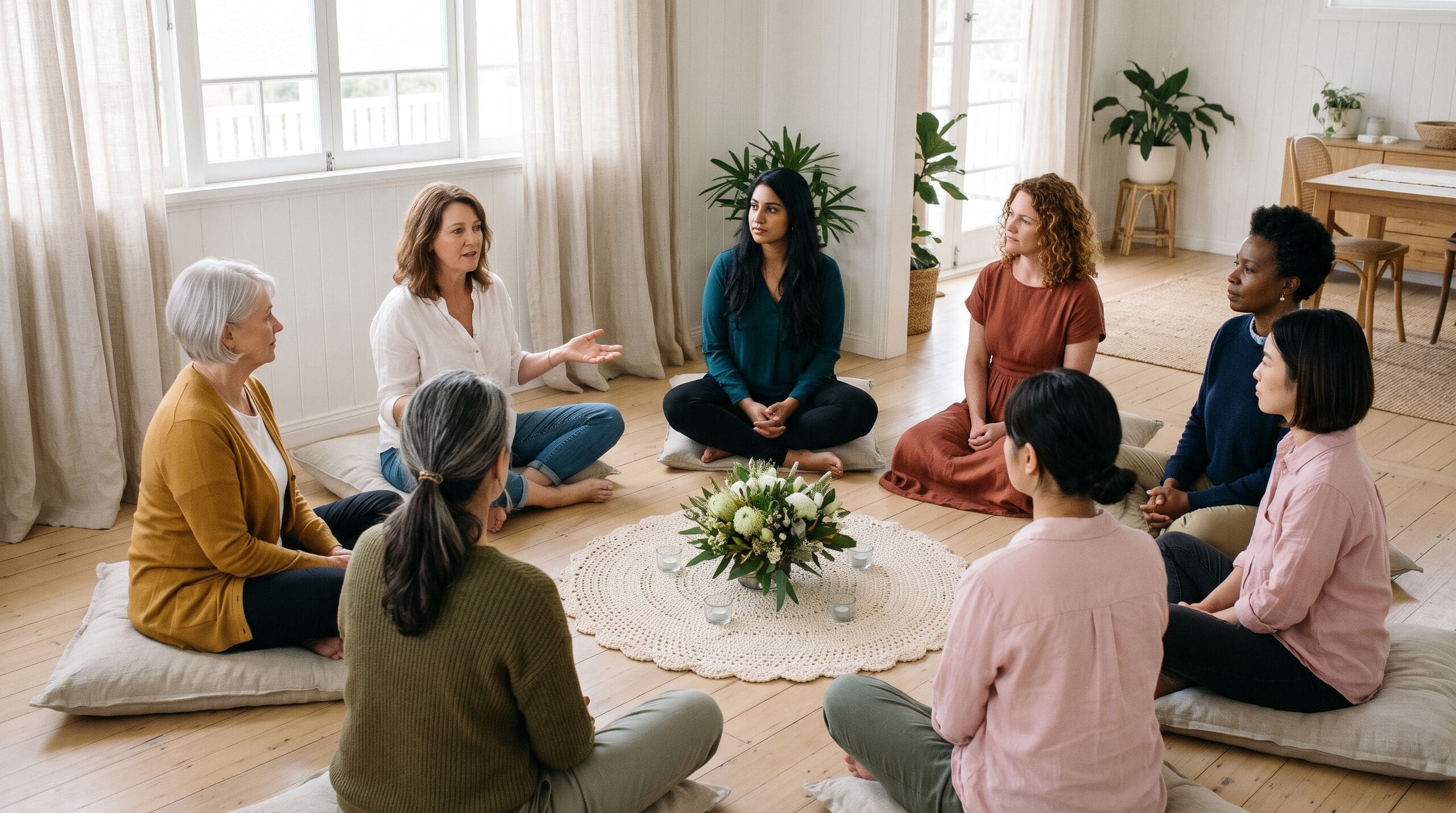
A women’s circle is a small group of women who sit together in a circle and take turns to share, listen and reflect. There is no stage and no teacher at the front. Instead, a facilitator holds the space so every woman can speak and be heard. If you have been to a women’s circle and wondered what it would take to run one, or you are simply curious about what happens in one, this guide covers the basics.
What is a women’s circle?
A women’s circle is a space to pause, connect, reflect, be witnessed and simply be yourself. Circles are usually small enough for everyone to have time to speak. Each gathering has an intention or theme, a simple structure and a facilitator who guides it.
It also helps to say what a circle is not. It is not group therapy, a class or a social catch-up, although it can share something with each of them. At its heart is listening: women speak from their own experience while the others listen without interrupting, fixing or giving advice.
A women’s circle is less about what is said and more about how it is heard.
What happens in a women’s circle?
No two circles look the same, but most follow a similar shape.
Opening the circle
The facilitator welcomes everyone, explains or revisits the circle agreements and leads a short practice to help the group arrive, such as a few minutes of breathing or a guided meditation.
A theme or practice
The theme gives the circle its focus. It might be explored through a question for everyone to reflect on, journaling, a meditation or a creative activity.
Sharing and listening
Each woman has the chance to share while the others listen. Many circles pass a talking piece so only one person speaks at a time, and anyone can choose to pass.
Closing the circle
The facilitator brings the circle to a close, often with a final round where each woman names something she is taking away. A clear ending helps everyone leave feeling settled.
Why women join circles
Women come to circles for many reasons: connection, wellbeing, personal development, spirituality, support through a life transition, creativity, or simply a place to gather and feel heard. Being properly listened to, without judgement or advice, is rare in everyday life. For many women, that is the draw.
How to start a women’s circle
Starting a circle is less about the setting and more about the care you bring to it. These steps will help you plan your first one.
1. Get clear on your intention
Ask yourself what you want women to experience in your space, how you want your circles to feel and who they are for. Your answers shape everything else, from the theme to the venue.
2. Choose a theme
A theme gives the circle a focus and helps women know what to expect. Women’s circle ideas and themes include:
New beginnings, for a new year or a new season
Life transitions, such as becoming a mother, changing careers or children moving out
Self-care and rest
Boundaries and learning to say no
Gratitude and celebration
Creativity and play
Nature and the cycles of the moon
3. Set circle agreements
Agreements help the space feel safe. Common ones include keeping what is shared confidential, speaking from your own experience, listening without interrupting or advising, and the right to pass. Share them at the start of every circle.
4. Plan the structure
Map out your opening, your theme activity, the sharing rounds and your closing, and decide how long each part will take. A clear structure frees you to focus on the women in front of you.
5. Create the space
Arrange the seating in a circle so everyone can see each other. A simple centrepiece, such as flowers or candles, gives the circle a focal point. Think about the practical details too: the size of the group, the venue, accessibility and how women will book.
6. Practise holding space
This is the step new facilitators most often underestimate, so it has its own section below.
What does holding space mean in a women’s circle?
Holding space means being fully present for others while they share, without trying to fix, rescue or advise. As a facilitator, it means creating a space that feels safe and respectful, guiding the circle with confidence and allowing each woman to have her own experience.
A beautiful set-up makes a circle look inviting, but it is how the space is held that makes women feel safe to speak. That is the real skill of facilitation, and it goes well beyond building a pretty circle.
Holding space also means knowing your limits. A women’s circle is not therapy. If a woman shares something that needs more support than a circle can give, a good facilitator responds with care and points her towards the right help.
Do you need training to run a women’s circle?
You do not need a licence to run a women’s circle in Australia, but facilitating well takes skill. Training helps you understand the role and responsibilities of a facilitator, hold space responsibly, set values and boundaries, and work with different personalities and perspectives in the group. It also gives you the chance to practise before you offer circles of your own.
The Women’s Circle Facilitator Training at The Australian Holistic Academy is an in-person intensive at Gerringong NSW, two hours south of Sydney, from 5 to 10 May 2027. It runs over four days of training and five nights, for a maximum of nine women, and it is IICT recognised. During the training you will plan and facilitate a women’s circle in a supported setting. You leave with printed course materials, ongoing online access to the course content and five professional images to use in your business.
The training is led by Michelle Garbutt, founder of The Australian Holistic Academy, who completed Imogen Bailey’s Honouring Heart Teacher Training. You do not need previous facilitation experience, only a genuine desire to hold space for women responsibly and in a way that feels authentic to you.
Next steps
Read the full program, dates and enrolment details on the Women’s Circle Facilitator Training page. If you would like to guide meditations in your circles, the Certificate in Meditation Teaching teaches you how to lead meditation for others.