Teaching meditation is one of the more accessible ways into holistic work, and one of the most misunderstood. People assume there is a licence to obtain, or that you need a decade of silent retreats before anyone will take you seriously. Neither is true. In Australia there is no government registration for meditation teachers, so what separates a credible teacher from an enthusiastic amateur is the training they chose and the accreditation that came with it.
Do you need a qualification to teach meditation in Australia?
Legally, no. Meditation teaching sits outside the government training system, alongside holistic counselling, kinesiology and the other complementary modalities, and nobody can stop you running a class tomorrow.
In practice, the answer is yes. Without recognised training you cannot obtain professional indemnity insurance, and without insurance no studio, workplace or retreat will book you. You also cannot join an accrediting body such as the International Institute for Complementary Therapists (IICT), which is what a cautious client or a corporate wellbeing manager checks for. Accreditation is not the legal gate. It is the commercial one.
There is no licence required to teach meditation in Australia. What you need is accredited training, practitioner insurance and membership of a professional body.
What a meditation teacher actually does
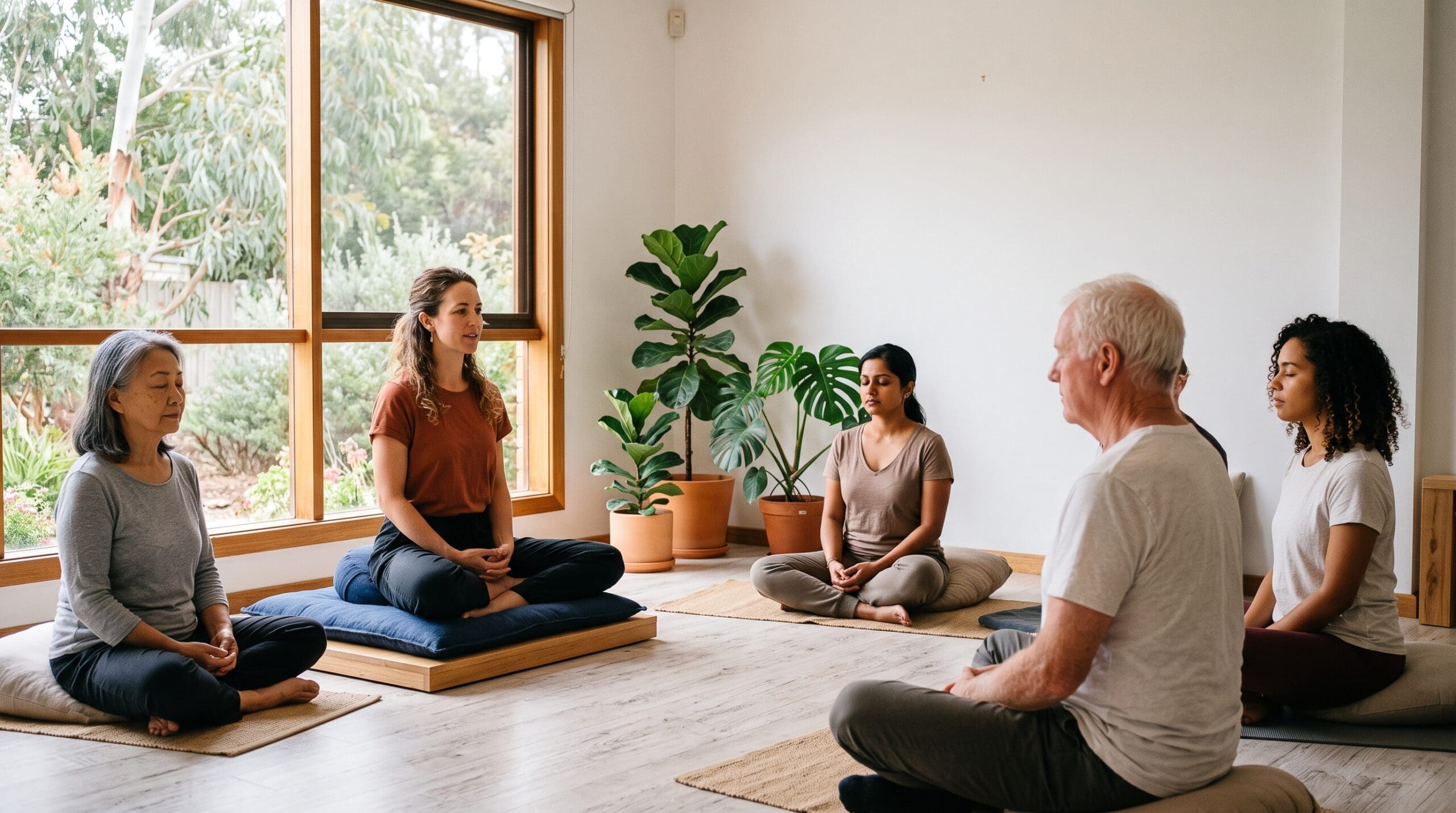
The job is broader than sitting at the front of a room and asking people to close their eyes. A working meditation teacher designs and leads classes, adapts techniques to the people in front of them, and holds steady space for whatever comes up. That last part is why nervous system regulation and trauma informed practice are core to any serious training rather than optional extras.
Most teachers work across several settings: weekly group classes in a studio or community space, private one to one sessions, workplace programs, online offerings and guided recordings, and sessions folded into a retreat or an existing yoga, reiki or coaching practice. Very few do only one of these. The mix is what makes the work sustainable.
The training pathway, step by step
1. Build your own practice first
Every credible program assumes you meditate. You do not need years of experience, but you do need a regular practice and some familiarity with more than one technique, because you will be teaching people whose minds work differently from yours. If you are starting from scratch, a few months of consistent daily practice before you enrol is plenty.
2. Complete an accredited meditation teacher training
This is the step that matters. Look for a program accredited by a recognised professional body, with a curriculum that covers the science as well as the tradition: how stress works in the body, the vagus nerve and the nervous system, brainwave states, and a range of techniques from mindfulness and concentrative meditation through to guided visualisation and body based practice.
Just as important is the teaching component. Knowing how to meditate and knowing how to teach it are different skills. A good program covers class design, facilitation, working with specific groups such as children, older adults or people living with anxiety, and the practicalities of virtual, corporate and community settings.
The Certificate in Meditation Teaching at The Australian Holistic Academy covers all of this across twelve modules, is delivered fully online and is accredited through the IICT. It also serves as the foundation course for the academy’s holistic counselling and coaching programs, so it is a first step rather than a dead end.
3. Learn the business side
This is where many trainings stop short and many new teachers stall. A certificate does not fill a class. The programs worth doing include holistic small business management and marketing in the curriculum, because the skill you will use most in your first year is not a meditation technique. It is the ability to get people through the door.
4. Get insured and join a professional body
Once you graduate from an accredited program you can apply for practitioner insurance and register as a member of your accrediting body. Do both before you take your first paid booking. Insurance is what lets a studio or employer engage you. Membership is what tells a client you are the real thing.
How long it takes
Considerably less time than most people expect. The Certificate in Meditation Teaching runs about six weeks full time at roughly 20 study hours a week, or twelve weeks part time at roughly 10 hours a week, which is how most people do it while working. Study is online and self paced within that window, with an online student community and support alongside.
What it costs
Accredited meditation teacher training in Australia is priced as a short professional course, not a degree, and payment plans are usually available. Current fees are set out on the meditation teacher training course page.
When you compare providers, check what is included. A cheaper certificate that leaves out the teaching practice, the business modules or ongoing support is not cheaper once you have to fill those gaps yourself.
Meditation teacher, meditation coach or meditation facilitator?
You will see all three titles, and people looking for training use them interchangeably. There is no regulated distinction between them. Teacher is the most common and the most widely understood. Facilitator tends to be used in corporate and community settings. Coach usually signals one to one work that blends meditation with goal setting or personal development.
What matters is not the title but the training underneath it. If you want to work one to one in the coaching style, look for a program that includes counselling and coaching skills for meditation teachers, because that is the piece a pure technique course leaves out.
Is it the right path for you?
Meditation teaching suits two groups in particular. The first is people looking for a career change into work that means something, often after their own experience of what a steady practice can do. The second is existing practitioners in yoga, reiki, breathwork, coaching or counselling who want a grounded, science aware modality to add to what they already offer. No prior experience is needed, and students range from 18 to well past retirement age.
It suits you less well if you want a credential to hang on a wall rather than a practice to build, or if you want to work in a clinical setting, where a different and government regulated pathway applies.
If you want to see how a full training is put together, the Certificate in Meditation Teaching sets out all twelve modules, from foundation studies and the science of stress through to teaching skills, working with specific groups and the business of running a practice. The accreditation page explains what IICT recognition means once you graduate.